A handbook, not a checklist

What to write down, and how to keep it true

EU AI Act · The AI Act File

The AI Act asks for a file, not a certificate. This is how to keep one current without a compliance department.

49 EURAvailable now
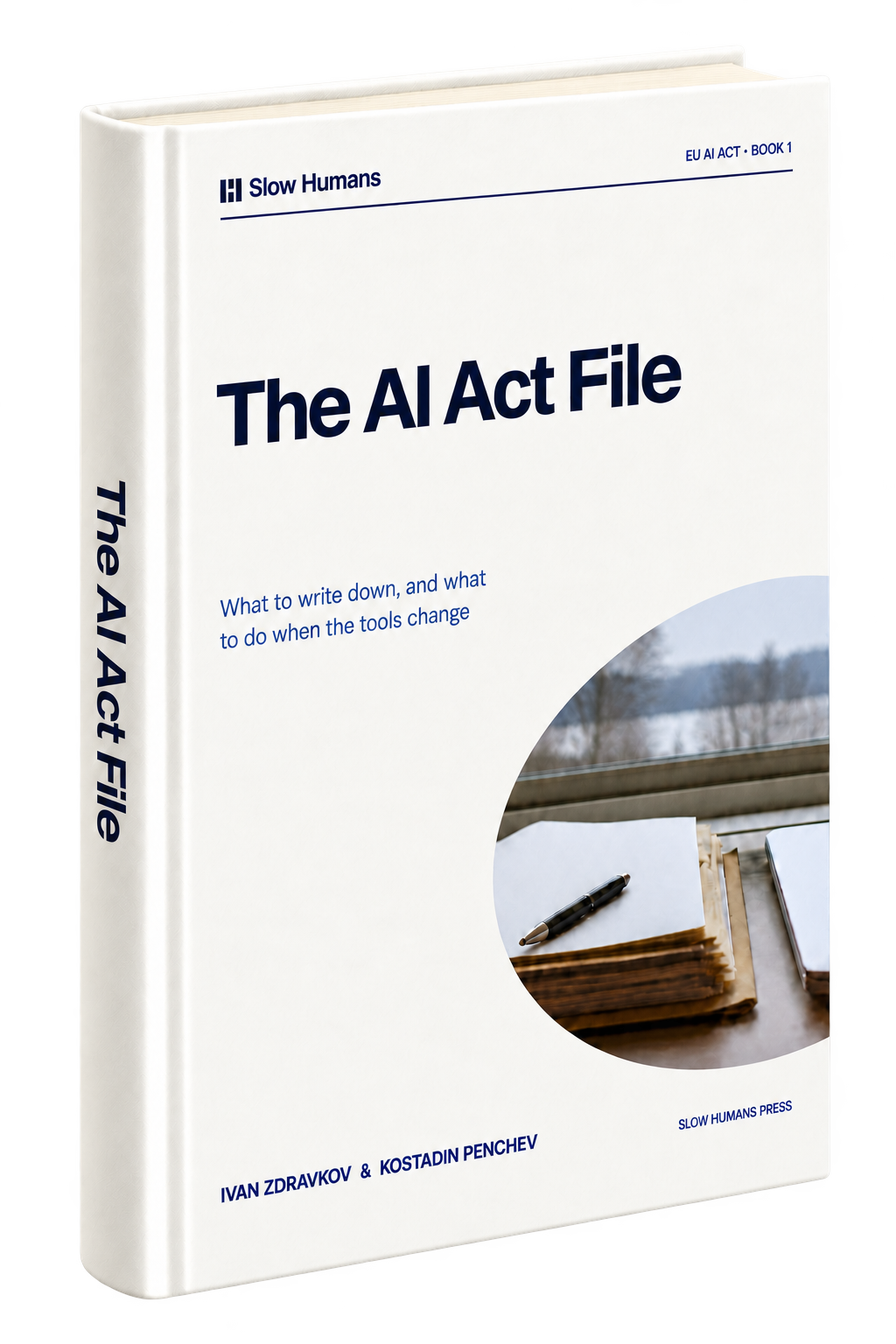
The cover of The AI Act File, first in the EU AI Act series.

The problem

The obligation is written as documentation that is kept up to date, so it has no finish line. A file assembled once describes a system that has already moved on, and the people who could notice are the people who already have other jobs.

How it works

  1. Work out which of your systems the file is actually for.
  2. Write each document so it records the decision and the conditions under which it holds, not the state on the day.
  3. Give every page an owner and a trigger, so a change in the business is what reopens it.

The handbook and the working files

  • The handbook

    176 pages, as PDF, EPUB and the web edition

    Which of your AI uses the regulation reaches, what each document is for, and how to keep it current.
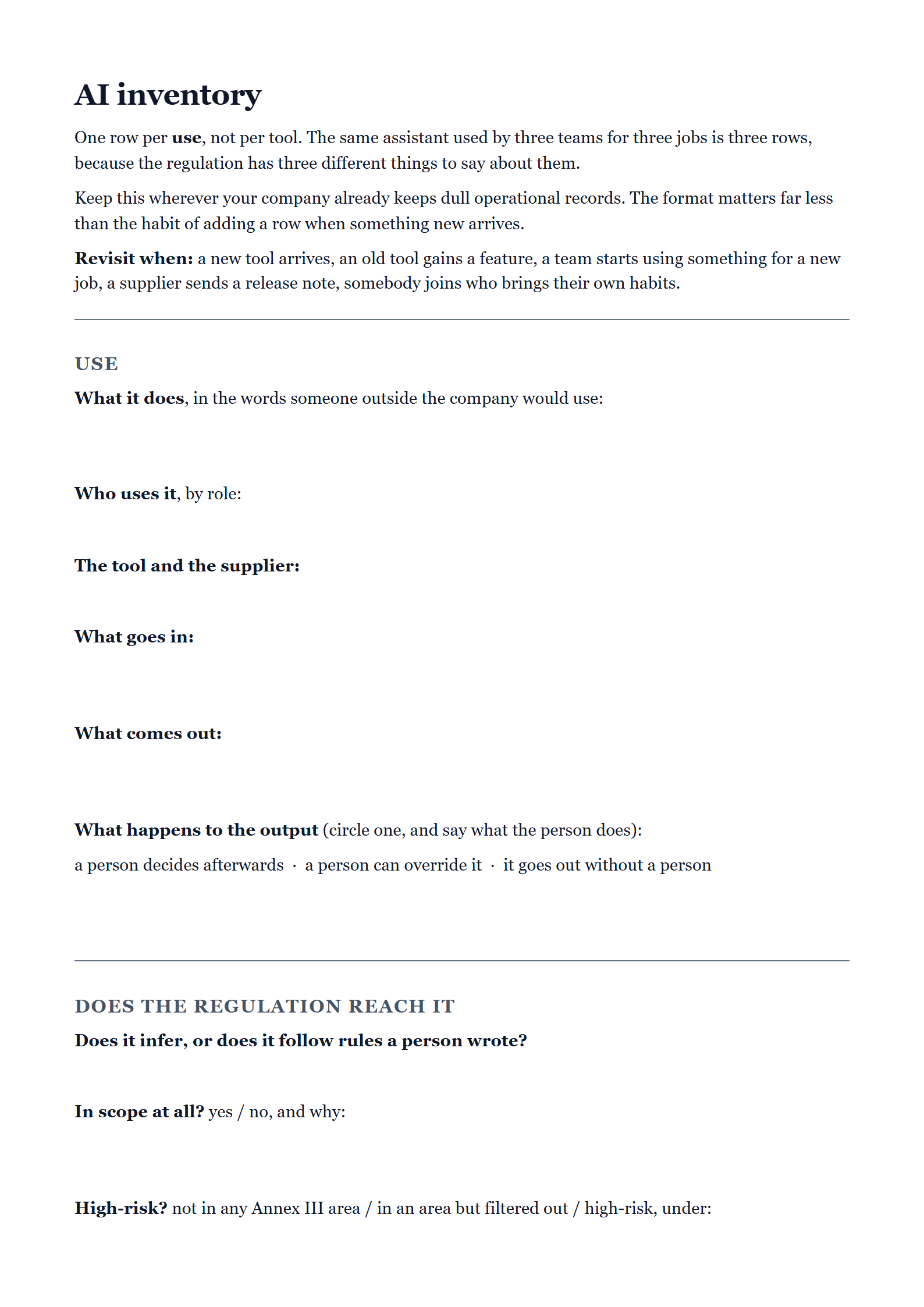
  • The AI inventory form, with spaces for what a use does, who uses it and what goes in and out.

    Ten printable forms

    PDF

    One sheet for each document the handbook asks you to keep, to print and write on.

  • The forms to type into

    Word file and spreadsheet

    The same ten forms as a Word file you type into, and the inventory as a spreadsheet.
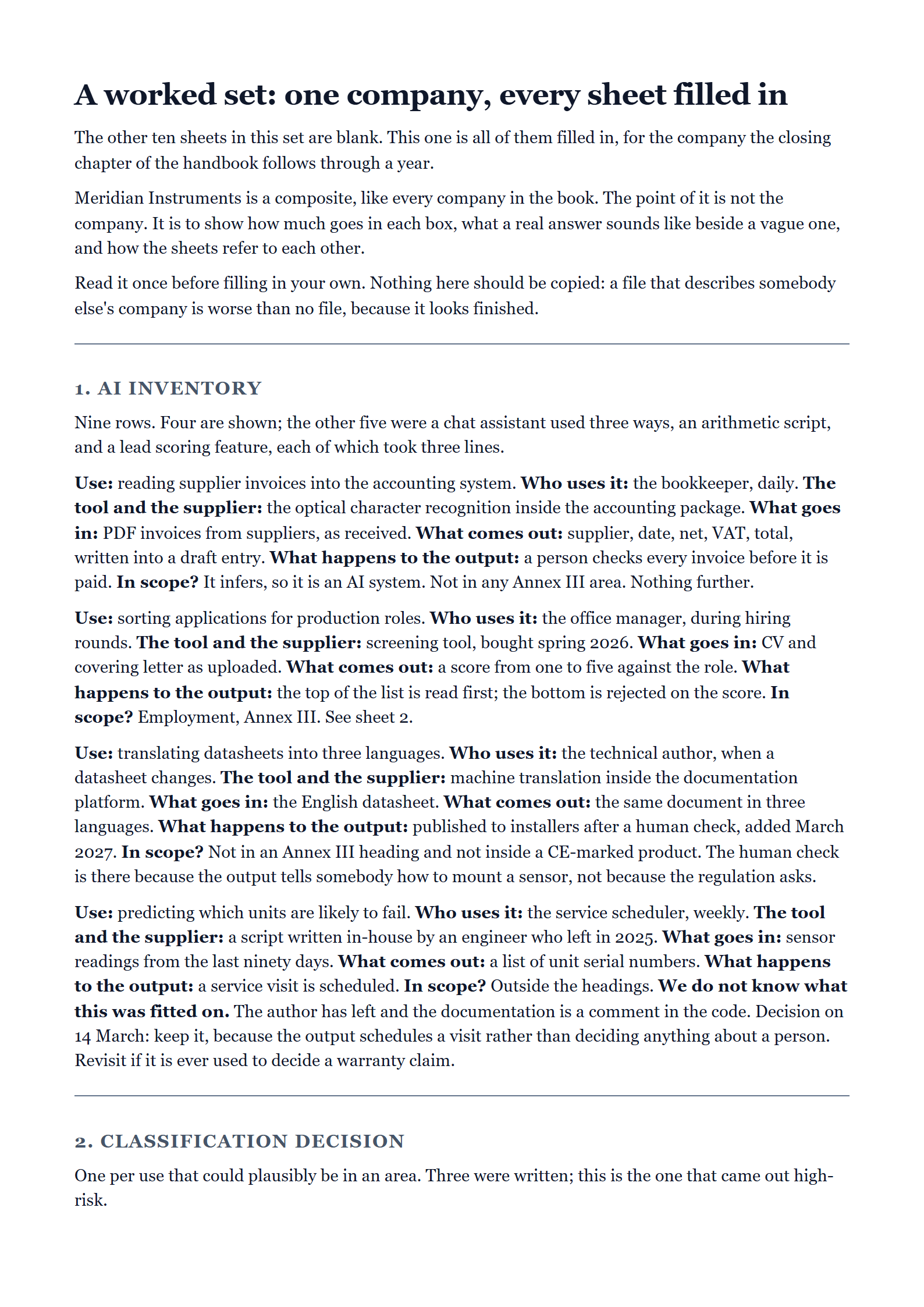
  • A page of the worked set, showing an inventory and a classification decision filled in for one company.

    A worked set

    PDF, with the forms

    All ten forms filled in for one company across a year, so you can see how much goes in each box.

Read the opening chapter

The opening chapter, in full, on working out which of your own AI uses the regulation reaches and which it does not.

Which of your AI the law touches · What the law makes of you · version 1.2.1

Read the opening chapter

What is in the book

  1. What the law makes of you

    1. Which of your AI the law touches
    2. The day you stop being a user
    3. The dates that apply to you
  2. Before you put AI into a process

    1. The obligation you already missed
    2. The uses that are simply forbidden
    3. Deciding whether a use is high-risk
  3. The measures inside the process

    1. Telling people they are dealing with a machine
    2. Oversight that is not a rubber stamp
    3. What the system has to remember
    4. The data you put in
  4. The file, and keeping it true

    1. What the file has to contain
    2. The records that are yours, not the vendor's
    3. How long you keep it
    4. Keeping it true
  5. When something changes

    1. The day the model changes under you
    2. When something goes wrong
  6. One company, all the way through

    1. One company, all the way through

What you'll learn

  • What each required document is for, in plain terms, and what a usable version of it looks like.
  • How to write a record that survives a model version change instead of being invalidated by it.
  • Which decisions need a lawyer and which are yours to make and write down.
  • How to size the work so one person with another job can keep it current.

Who it's for

For

  • An owner of a small company that has put an AI tool somewhere in the business and does not know what the file should contain.
  • The person given responsibility for AI integrations, who has to produce something defensible without a compliance team.
  • A lawyer or consultant who advises on this and wants the engineering reality behind the paperwork.

Not for

  • A large organisation with an established compliance function and its own templates.
  • A reader who wants the regulation summarised article by article.

Evidence

Every requirement the book describes is tied to the article it comes from, checked against the current text of the regulation, including its 2026 amendment. When the regulation changes, the book is updated and the new version appears in your library.

Pricing

The handbook and the working files

49 EUR

  • The handbook, 176 pages, as PDF, EPUB and the web edition
  • Ten printable forms, one per document the handbook asks you to keep
  • The same ten as a Word file you type into, and the inventory as a spreadsheet
  • A worked set: all ten filled in for one company across a year
  • Every chapter that has a form says which one to open and what goes in it
  • Updates to this edition when the text it describes changes

Required by law. Buying online in the EU normally gives you fourteen days to change your mind. For a book you can open straight away, that right ends when your access starts, and we need your agreement first. See cancelling and refunds.

We will occasionally email you about related books from Slow Humans. You can stop this with one click in any of those emails.

Questions

Do I need a lawyer to use it?
For most of the file, no. The book shows what each document is for and what a usable one looks like, so you can write it yourself. The few decisions worth a lawyer's signature are marked, so you know exactly when to ask and what to ask.
Will it help me decide whether my system is high-risk?
Yes. It walks you through how the classification works and the questions to put to each of your systems, so you reach the decision yourself and write down why it holds.
Can I edit the files?
Yes. The ten forms come as a Word file you type into and the inventory as a spreadsheet, as well as the printable PDF.
What happens when the rules change?
You get the update at no extra cost. The book is kept current with the regulation, and your library always holds the latest version.
Is this a subscription?
No. You buy the book once.

The handbook and the ten working files, for 49 EUR

Buy the book