For employers who use AI on candidates and staff

The AI already in your HR tools, and what you owe the people it decides about

EU AI Act · The AI Act at Work: Hiring and Managing People with AI

Ranking, rota and scoring features arrive with updates nobody decided on. This is how to find them, place them under the AI Act and run them in a way you can show, without a compliance department.

29 EURAvailable now

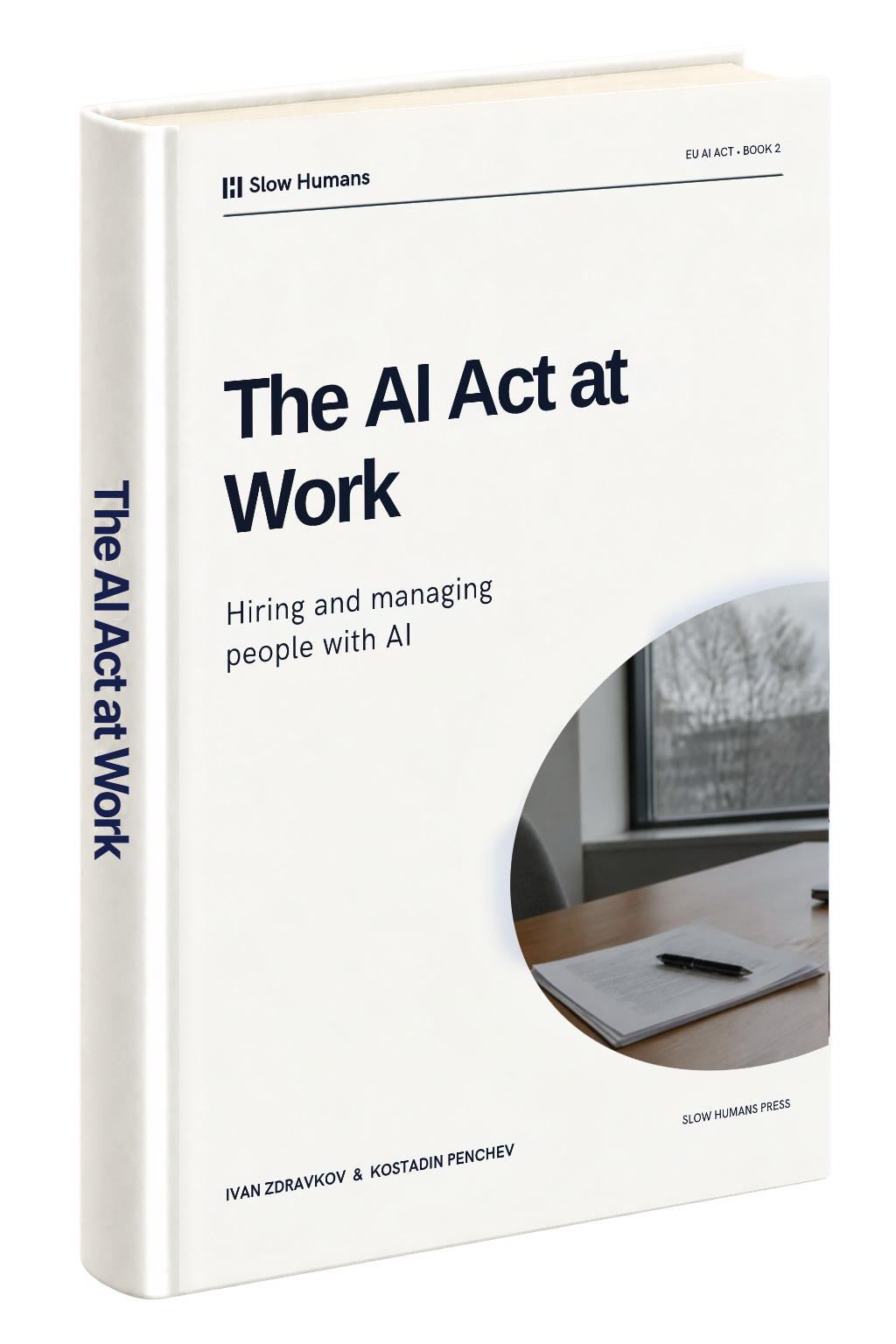
The cover of The AI Act at Work, second in the EU AI Act series.

The problem

The applicant tracking system starts ranking candidates after an update. The rota tool starts weighing who worked last weekend. The record still calls them a database and a calendar, and the first person to notice is often a candidate who was never read or an employee who keeps getting the nights. By then the company has to explain a decision it did not know a system was making.

How it works

  1. Trace one process, the one that reaches the most people, and find every place a system ranks, scores or allocates.
  2. Write each use down once, with what it feeds, who it reaches, what the supplier says it is for and what you decided about it.
  3. Put a person with time and authority in front of each output, tell the people it decides about, and answer them when they ask why.

The book and the working files

  • The book

    21 chapters, as PDF, EPUB and the web edition

    Where AI already decides in hiring and staff management, what the law makes of it, and how to run it so you can show what you did.

  • Eight printable forms

    PDF

    The register of AI uses, one sheet per use, the supplier letter that grows into a vendor questionnaire, the oversight log, the two notices, the response to a request for an explanation and the complaints log.

  • The forms to type into

    Word file and spreadsheet

    The same eight forms as a Word file you type into, and the register as a spreadsheet with a worked example beside it.

  • A worked set

    PDF, with the forms

    Every form filled in for one logistics company across one year, so you can see how much goes in each box.

Read the opening chapter

The opening chapter, in full, on the ranking and scoring features that reach HR software through updates, and the short letter that gets your supplier to say what they do.

The AI you did not decide to buy · Where AI already decides · version 1.0.0

Read the opening chapter

What is in the book

  1. Where AI already decides

    1. The AI you did not decide to buy
    2. What you may never do at work
    3. What the law calls employment AI
    4. Help with writing, or a say in someone's life
    5. Two dates, and one of them has passed
  2. Finding every use and writing it down

    1. Start with one process
    2. Looking inside the HR system
    3. The register of AI uses in HR
    4. One sheet per use
  3. Who answers for it

    1. You are the deployer, and someone inside must answer
    2. What to ask the vendor, and what an answer looks like
    3. What your HR people and managers need to know
  4. Oversight that survives a busy week

    1. The person who signs off has no time
    2. Shifts, tasks and scores
    3. Checking a ranking you cannot see inside
    4. The oversight log, and the system's own logs
  5. Telling people, and answering them

    1. Telling candidates
    2. Telling employees and their representatives first
    3. When someone asks why
    4. When it gets someone wrong
  6. One company, end to end

    1. One company, one year

What you'll learn

  • How to find the AI in software you already use, from its settings, its release notes and its contract.
  • Which of your uses are high-risk under Annex III point 4, and how to write the classification so it survives a question.
  • What to ask a vendor, and how to tell a promise from a description and a description from evidence.
  • How to set up oversight that a busy HR team can actually keep, and a log that shows it happened.
  • What to tell candidates, staff and their representatives, and how to answer a person who asks why.
  • What to do when a system gets someone wrong.

Who it's for

For

  • An HR lead or owner of a company with tens or a few hundred staff, whose hiring or rota software has started ranking, scoring or allocating people.
  • The person given responsibility for the HR systems, who has to produce something defensible without a compliance team.
  • A lawyer, works council member or consultant who advises employers and wants to see how this works inside the HR process.

Not for

  • A company that builds AI systems for HR and sells them; this book is written for the employer who uses them.
  • A reader who wants the regulation summarised article by article.

Evidence

Every requirement the book describes is tied to the article it comes from and checked against the current text of the regulation, including its 2026 amendment, and the GDPR where it applies to the same decisions. Each claim is listed once at the end of the book with the date it was last checked. When the regulation changes, the book is updated and the new version appears in your library.

Pricing

The book and the working files

29 EUR

  • The book, 21 chapters, as PDF, EPUB and the web edition
  • Eight printable forms, one for each record the book asks an employer to keep
  • The same eight as a Word file you type into, and the register as a spreadsheet
  • A worked set: every form filled in for one company across one year
  • Every chapter that has a form says which one to open and what goes in it
  • Updates to this edition when the text it describes changes

Required by law. Buying online in the EU normally gives you fourteen days to change your mind. For a book you can open straight away, that right ends when your access starts, and we need your agreement first. See cancelling and refunds.

We will occasionally email you about related books from Slow Humans. You can stop this with one click in any of those emails.

Questions

Do I need a lawyer to use it?
For most of the work, no. The book shows what each record is for and what a usable one looks like, so you can write it yourself. The few questions worth a lawyer's view are marked, so you know when to ask and what to ask.
Will it help me decide whether a tool is high-risk?
Yes. It walks you through the employment line of Annex III and the way back out of it, use by use, so you reach the decision yourself and write down why it holds.
Does it cover my country's employment law?
It covers the AI Act and the GDPR as they apply to these decisions, and it says where national law and collective agreements can ask more, such as informing or consulting your staff's representatives, so you know what to check.
Can I edit the files?
Yes. The eight forms come as a Word file you type into and the register as a spreadsheet, as well as the printable PDF.
What happens when the rules change?
You get the update at no extra cost. The book is kept current with the regulation, and your library always holds the latest version.
Is this a subscription?
No. You buy the book once.

The book and the eight working files, for 29 EUR

Buy the book